Solar Panels
 Solar Controllers
 Batteries
 Inverters
 Mains Chargers
 DC-DC Chargers
 Cables/Accessories
 Power Converters
 Monitoring
 Kits
Kits





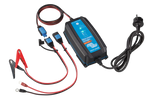


Charging LiFePO4 Batteries With a Lead-Acid Charger: Risks and Reality

The Transition to Lithium Iron Phosphate in Off-Grid Systems
The shift from traditional lead-acid power to lithium iron phosphate (LiFePO4) has revolutionised the recreational vehicle, marine, and 4x4 industries. LiFePO4 technology offers a fraction of the weight, a dramatically higher cycle life, and the ability to safely discharge deeper than Absorbent Glass Mat (AGM) or flooded lead-acid batteries.
However, when making this upgrade, users frequently ask whether they can retain their existing lead-acid mains chargers, solar regulators, or alternator charging systems. A common assumption is that because both systems operate nominally around 12 volts, the chargers are universally compatible. This is a fundamental misunderstanding of battery chemistry and charging algorithms.
While a 12V lead-acid charger will input energy into a 12.8V LiFePO4 battery, it relies on voltage parameters and charging phases that are actively harmful to lithium cells over time. To maximise the lifespan of your investment, it is vital to understand exactly how these charge profiles differ.
Core Differences in Battery Chemistry
To understand why chargers are not interchangeable, we must first look at how these two distinct battery chemistries store and release energy.
Lead-acid batteries, including AGM and GEL variants, operate on a chemical reaction between lead plates and a sulfuric acid electrolyte. They suffer from a high rate of self-discharge and are prone to a condition called sulfation. When a lead-acid battery remains in a discharged state, lead sulfate crystals harden on the internal plates, which permanently reduces capacity. Because of this, lead-acid batteries must be continuously maintained at a 100 percent state of charge to prevent irreversible degradation.
Furthermore, lead-acid batteries suffer from a phenomenon known as the Peukert Effect, where their usable capacity decreases rapidly as the rate of discharge increases. Conversely, LiFePO4 batteries deliver near constant capacity regardless of the discharge rate, maintaining a stable voltage curve until they are almost entirely depleted.
LiFePO4 batteries operate on entirely different principles. They utilise lithium ions moving between an anode and a cathode. LiFePO4 chemistry boasts a remarkably low self-discharge rate, typically losing only a few percent of its charge per month. Furthermore, lithium batteries do not sulfate. In fact, lithium chemistry experiences optimal physical stress when resting at a partial state of charge, ideally between 40 and 80 percent. Forcing a lithium battery to remain constantly at a 100 percent state of charge accelerates internal wear.
The Lead-Acid Charging Algorithm Explained
Because lead-acid batteries require continuous maintenance, chargers designed for this chemistry employ a multi-stage algorithm that keeps the battery artificially elevated at maximum capacity.
- Bulk Phase: The charger delivers its maximum rated current to rapidly replace the bulk of the depleted energy. The voltage steadily rises until it hits a pre-set absorption threshold, usually between 14.4V and 14.7V depending on the exact manufacturer specifications.
- Absorption Phase: The charger holds the voltage at this elevated limit while the current naturally tapers off. For a lead-acid battery, this phase is prolonged to ensure the heavy lead plates are fully saturated.
- Float Phase: Once saturation is reached, the charger drops the voltage to a lower holding level, typically between 13.5V and 13.8V. The charger remains in this phase indefinitely, providing a continuous trickle of current to counteract the natural self-discharge of the lead-acid chemistry.
- Equalisation Phase: Many flooded lead-acid chargers feature an automatic desulfation or equalisation mode. This phase periodically spikes the voltage to 15V or higher to intentionally boil the electrolyte and break down stubborn lead sulfate crystals.
The Lithium (LiFePO4) Charging Algorithm
A dedicated lithium compatible battery charger follows a much simpler and cleaner algorithm, intentionally omitting the maintenance phases that damage lithium cells.
- Bulk Phase (Constant Current): Similar to lead-acid, the charger delivers maximum current. A standard 12.8V nominal LiFePO4 pack, composed of four 3.2V cells in series, is typically charged to a bulk voltage of 14.2V to 14.4V.
- Absorption Phase (Constant Voltage): The voltage is held briefly to allow internal cell balancing. Unlike lead-acid, this phase is kept extremely short.
- Charge Termination: This is the critical difference. Once the LiFePO4 battery is fully saturated, the charger turns off completely or drops to a benign standby voltage. There is no continuous high-voltage float applied. The battery is allowed to rest at its natural full resting voltage, which is typically around 13.3V to 13.5V.
Why Lead-Acid Chargers Damage Lithium Cells
Using a lead-acid charger on a lithium battery exposes the sensitive internal cell structure to three primary hazards: continuous float charging, equalisation pulses, and improper voltage calibration.
The Danger of Continuous Float Charging
The most significant threat to a LiFePO4 battery is the float stage. Lead-acid chargers apply a continuous float charge to compensate for self-discharge, a feature that lithium chemistry cannot tolerate. Maintaining lithium based batteries with a float charge shortens their lifespan and places unnecessary stress on the internal components . Continuous high voltage hold can lead to a condition known as lithium plating, where metallic lithium forms inside the cell, increasing internal resistance and permanently reducing capacity.
Desulfation and Equalisation Pulses
If your lead-acid charger enters an automatic equalisation mode, it will pulse high voltages designed to dissolve sulfate crystals. Because LiFePO4 batteries do not sulfate, these high voltage spikes serve only to overcharge the cells. Voltages exceeding 14.6V will rapidly degrade a 12V nominal lithium pack and will inevitably force the system into a sudden emergency shutdown.
Prolonged Absorption Times
Lead-acid chargers maintain their high absorption voltage for several hours to slowly saturate dense lead plates. Lithium batteries absorb charge much faster and possess very low internal resistance. Holding a lithium battery at a high absorption voltage for four hours will overwork the cells and generate excessive internal heat.
The Reality of the Battery Management System (BMS)
A frequent misconception in the off-grid community is that the Battery Management System (BMS) inside a drop-in lithium battery acts as a charge controller, actively regulating incoming voltage to safe levels. This is factually incorrect and represents a dangerous misunderstanding of system design.
The BMS is highly relevant to overall safety, but it functions as a final emergency circuit breaker, not a voltage regulator. If a lead-acid charger outputs 15V during an equalisation cycle, the BMS does not step that voltage down to a safe 14.2V. Instead, when the internal cells reach their absolute maximum safety threshold, the BMS physically severs the connection to protect the battery from catching fire or suffering catastrophic failure .
Relying on the BMS to stop a mismatched charger is an abusive practice. When the BMS triggers a hard cutoff under high electrical load, it creates a sudden open circuit. This abrupt disconnection can cause massive voltage spikes, known as load dumps, that can severely damage the charger itself, the vehicle alternator, or sensitive 12V electronics sharing the same electrical bus. A properly designed system should rarely, if ever, trigger the BMS overvoltage protection during normal operation.
Charging Lithium Batteries With an AGM Charger
A common query from users is whether an AGM or GEL specific charger can bridge the gap. AGM and GEL batteries require lower absorption and float voltages than flooded lead-acid batteries, often hovering around 14.2V to 14.4V for bulk and 13.5V for float.
Because these parameters are much closer to LiFePO4 requirements, an AGM or GEL setting is safer than a flooded lead-acid setting. If you are stranded off-grid and must use an AGM charger to replenish a depleted lithium battery, it can be done temporarily with extreme caution.
If you choose to use an AGM or GEL charger, you must ensure that any automatic equalisation features are entirely disabled. Furthermore, because the charger will still enter a float phase of 13.5V once full, you must manually disconnect the charger from the battery immediately after the bulk phase is complete. Leaving the AGM charger connected indefinitely will subject the lithium battery to the damaging continuous float charge described earlier.
Alternators and Mobile Charging
When integrating lithium batteries into a 4x4 or caravan running off a vehicle's alternator, the rules of charging remain just as critical. Standard vehicle alternators are essentially raw lead-acid chargers. They are designed to replenish a starter battery and then float indefinitely at high voltages.
Connecting a LiFePO4 battery directly to a standard alternator not only risks overcharging the battery via continuous float but also risks burning out the alternator itself. The lithium battery's exceptionally low internal resistance will draw maximum current continuously until full, often overheating the alternator windings. This scenario necessitates the use of a dedicated DC-DC charger or specialised lithium compatible alternator regulators to safely manage the current limit and apply the correct multi-stage charging algorithm.
Conclusion and Best Practices
Given the distinct chemistry, voltage parameters, and charging algorithms of the two technologies, attempting to charge a lithium battery with a traditional lead-acid charger introduces unnecessary risk to your system. While a closely matched AGM profile might work as a temporary measure if manually supervised, it is fundamentally unsuitable for long term use.
Considering the significant financial investment required for high quality lithium battery systems, compromising the lifespan of the cells to save a small amount on a charger is a false economy. To ensure your system operates safely, efficiently, and for its fully rated cycle life, it is imperative to use equipment specifically engineered for lithium chemistry.
Whether you require mains chargers for grid connections, DC-DC chargers for mobile charging on the move, or solar charge controllers for off-grid renewable energy, upgrading to programmable or dedicated lithium compatible hardware is the only reliable way to protect your power system.